August is the month Australian running stops apologising for the weather. For most of the country this is the bottom of winter — frosts inland, water still cold enough to end a triathlon season, mornings that ask something of you before the sun clears the treeline. And that is exactly the point. The heat that makes a February marathon a survival exercise is gone, the humidity with it, and the runner who has spent June and July grinding through base mileage in the dark finally has a reason to find out what it was for.
The racing on offer this month reflects a country that runs very differently depending on where you stand in it. On the Sunshine Coast, August is the one stretch of the year when a fast coastal marathon is genuinely comfortable rather than a gamble against the forecast. In the Perth Hills, the same weeks are the short green window before the whole landscape dries out and closes for fire season. In Bass Strait, an island most Australians could not point to on a map opens itself to a few hundred visiting runners. The season is the same word everywhere and a completely different proposition in each place.
What follows is not a ranking. It is six races across six states and territories, chosen because each one tells you something specific about running where it happens — the terrain, the timing, the kind of person who shows up. Some are built for a personal best; one is built for almost the opposite. Read them as a map of what winter racing in Australia actually looks like, and enter the one that sounds like your kind of morning.
Queensland's best marathon weather lasts about six weeks, and this is it
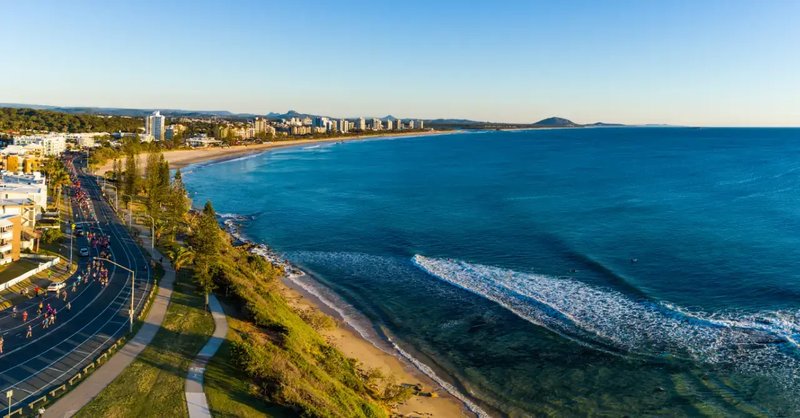
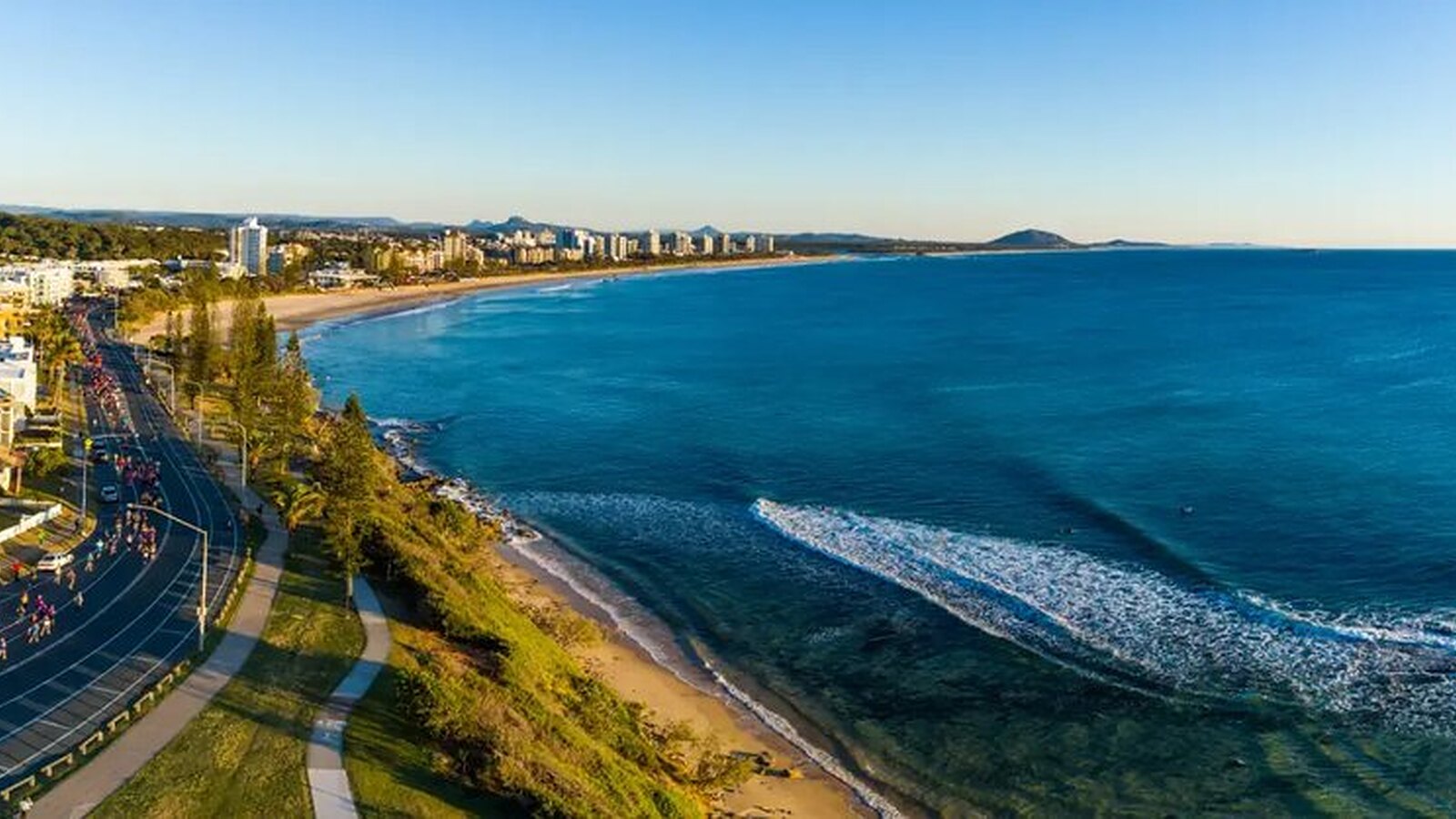
Most of the year, running a marathon in south-east Queensland means negotiating with the humidity and losing. The Sunshine Coast Marathon Festival, run on 2 August out of Alexandra Headland, exists in the narrow window where that stops being true. Early-August mornings on the coast sit around ten to twelve degrees with low humidity and a light offshore breeze — the conditions distance runners drive across states to find, and here they arrive for a few weeks before spring warms everything back up.
The course makes the most of them. It runs the esplanade between Mooloolaba and Alexandra Headland and back, flat almost the entire way, hugging the beach with the water on one side and the low headland on the other. There is no hill to speak of and very little in the way of tight turns, which is the whole appeal: this is a course you race, not one you manage. Runners chasing a Boston qualifier or a first sub-four turn up here specifically because the profile gives nothing back and takes nothing away.
The festival stacks a half marathon, ten and five kilometre events and kids' runs around the main event, so it works for a family weekend as much as a solo project. Because the shorter distances go off across the same August morning, a household can split across three start lines and still be finished in time for the same breakfast. If you are new to the distance, the flat profile is forgiving in a way a hillier course never is — you can hold an even effort from the first kilometre to the last without the terrain rewriting your pacing plan. If you are chasing a time, it removes every excuse except your own training.
Who it is not for: anyone who wants a race with a view that changes or a course that surprises them. The Sunshine Coast course is honest and slightly monotonous by design, and that is precisely why the fast runners love it. Come for the clock, not the scenery.
Where the thing overtaking you might be a steam locomotive
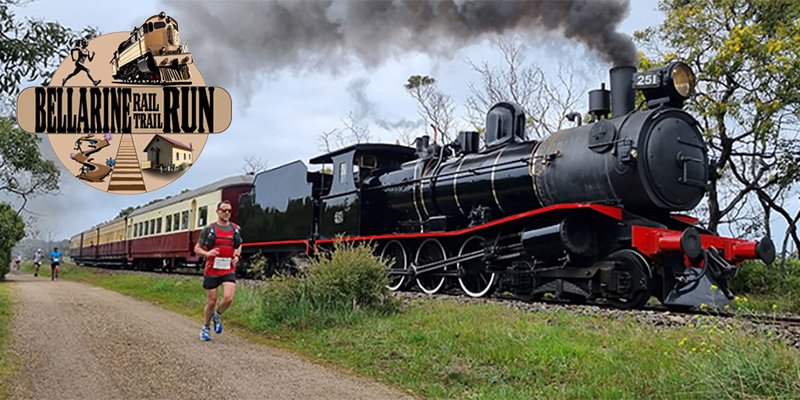
The Bellarine Rail Trail Run on 23 August starts at Queenscliff, the old fort town at the mouth of Port Phillip, and follows a disused railway line across the peninsula — 17 kilometres one way, or 34 out and back for those who want the round trip. The trail shares its corridor with the Bellarine Peninsula Railway, a heritage line still worked by steam, which means the genuinely strange possibility of being passed by a locomotive while you run.
The reason a rail trail makes such good running has nothing to do with the trains and everything to do with the engineering. Railways were graded for locomotives that could not climb, so the ruling gradient on a line like this is barely more than one in a hundred. There is no sharp pinch to break your rhythm, no descent steep enough to trash your quads — just a long, wide, gently inclined surface that lets you settle into a pace and stay there. For a first attempt at 17 or 34 kilometres, that predictability is worth more than any amount of enthusiasm.
It also makes the Bellarine a good place to run a controlled long tempo without the interruptions a road race throws at you. The surface is compacted gravel with a short sealed section, wide enough that passing is never a scramble, and well marked throughout. You are running through farmland and coastal scrub with the occasional level crossing, close enough to the towns that support is never far away. The out-and-back option has a quiet advantage here too: the turnaround splits the effort into two halves you can pace against each other, and you cover the same ground twice, which on a first long run is reassuring rather than dull.
This is a race for people building toward a longer road event, for first-timers who want distance without technical footing, and for anyone who likes the idea of a steam train for company. It is not a race for trail runners chasing singletrack and elevation — there is none here, and that is the entire point.
An island of nine hundred people opens itself to a few hundred runners
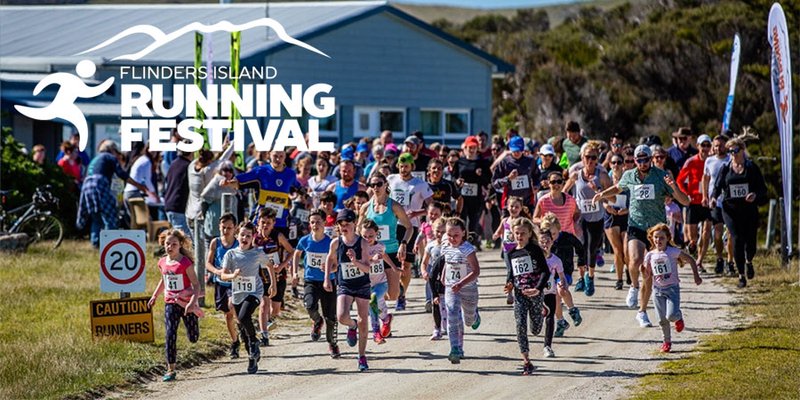
Flinders Island sits in Bass Strait, the largest of the Furneaux Group, roughly halfway between the Tasmanian mainland and the Victorian coast. Fewer than a thousand people live there. Getting to the Flinders Island Running Festival on 4 September means a light aircraft or a ferry and a commitment to a whole weekend, because you cannot casually drop in and out. That barrier is the first thing the festival asks of you, and it filters for exactly the kind of runner it wants.
The distances run from a three-kilometre event up to the full marathon, and the courses move between the island's granite country and its empty beaches, under the Strzelecki peaks that rise straight out of the sea at the island's south end. What the event website cannot convey is the arithmetic of scale: on an island this size, a race field is a visible fraction of the entire population, and the community does not so much host the event as absorb it. The volunteers at the aid stations are a good slice of the people who live there.
That changes the texture of the weekend. This is not a race you fit into a Sunday; it is a small journey with a run in the middle of it, and the running is inseparable from the place. Early September also lands the event at the turn of the season here — the worst of the Bass Strait winter easing, the island beginning to green, but well before any summer crowd, so you get the place close to its quietest. You come back with a sense of an island most Australians will never visit, and the distance almost becomes secondary to having gone at all.
It suits the runner who treats racing as a reason to end up somewhere interesting, who is comfortable being self-sufficient and a long way from a supermarket. It does not suit anyone who wants convenience, a big field, or a race they can drive home from that afternoon. The effort of getting there is not a drawback of this one — it is most of the reward.
The Perth Hills are green for about a month, and August is the month
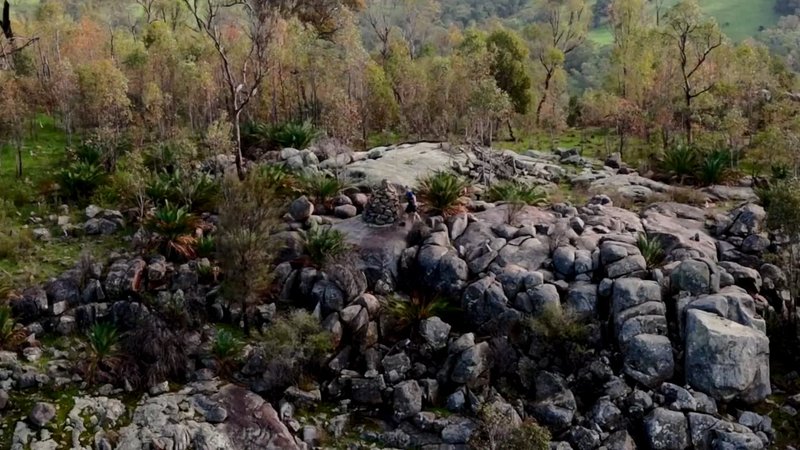
Transcend Trails runs on 22 August through Walyunga National Park on the Swan River's upper reaches, out toward Cobblers Pool in the Perth Hills. The timing is not incidental. Late August is the tail of Western Australia's wet season, which is the brief stretch when the Darling Scarp is actually green — creeks running, the granite dark with damp, the understorey of grass trees and wildflowers coming into its short season. A few weeks either side of now and this country begins its long slide into summer, when it dries to tinder and much of it closes for fire season.
The terrain is granite and jarrah-marri forest, with the great rounded outcrops the Perth Hills are built on breaking through the bush. It is proper trail — rocky underfoot, technical in places, with the granite offering good grip when dry and surprisingly little when wet, so the same footing that feels secure on the climb can be treacherous on the way down. Runners who only train on the road tend to be caught out by how much attention the surface demands.
The event offers a range of distances so you can match the day to your trail experience rather than your road fitness, which are not the same thing. An hour on this ground works muscles and reflexes that a flat long run never touches — the constant micro-adjustments to rock and root leave you sore in places road mileage never finds. The reward is a stretch of the Perth Hills at the one moment of the year it looks like this, with the wildflowers of the Darling Scarp just beginning and the river running clear below the trail.
This is a race for runners who already have some trail comfort and want to use it while the country is at its best. It is not the place to run your first-ever off-road event at speed — the footing is unforgiving of a wandering mind. Come with your eyes on the ground and your expectations set to the terrain, not the clock.
A capital planned around bush corridors makes a very strange hundred
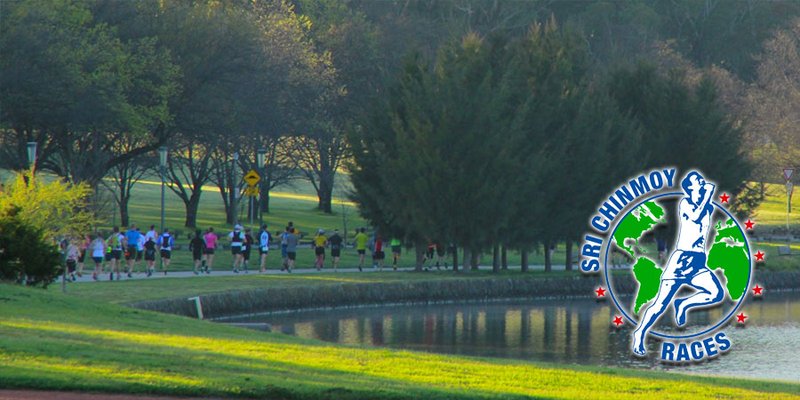
Canberra was planned with bushland corridors left standing between its districts, ridgelines and nature reserves threading through the suburbs rather than being flattened by them. The Sri Chinmoy Canberra Trail 100 on 2 August uses that inheritance to build something unusual: a hundred-kilometre trail race, run solo or as a relay, that stays almost entirely on connected nature-park trails while never being far from the city that surrounds them. You can be deep in bush on a ridge and still see the roofs of a suburb below you.
The other thing worth knowing is who runs it. Sri Chinmoy events are put on by volunteers in a tradition that predates the modern race-expo economy entirely — no sponsors' village, no finisher-medal industrial complex, entry fees that look like a mistake next to a commercial ultra. What you get instead is a low-key, generous, unhurried event that treats the running as the point and everything else as optional. For a certain kind of runner that is not a compromise; it is the reason to be there.
August in Canberra means genuine cold — frost on the grass at the start, single digits for much of a long day, the kind of clear high-country winter that suits a sustained effort far better than heat ever could. The relay option matters here: it lets a team split the hundred kilometres into legs and hand the trail between them, which turns an event most people would never attempt solo into something a group of club runners can share across a single long day. The trails ring the city on the mountains that define it, and running a hundred kilometres of them, in one push or in turns, is a strange and intimate way to learn a capital most people only ever drive through.
It is a race for ultra runners who value substance over spectacle and do not need a production to feel like they have raced. It is not for anyone who wants the noise, the crowds and the merchandise of a big-city event. The quiet is deliberate, and for the people who come back year after year, it is the whole appeal.
Racing the seven kilometres half of Sydney already trains on
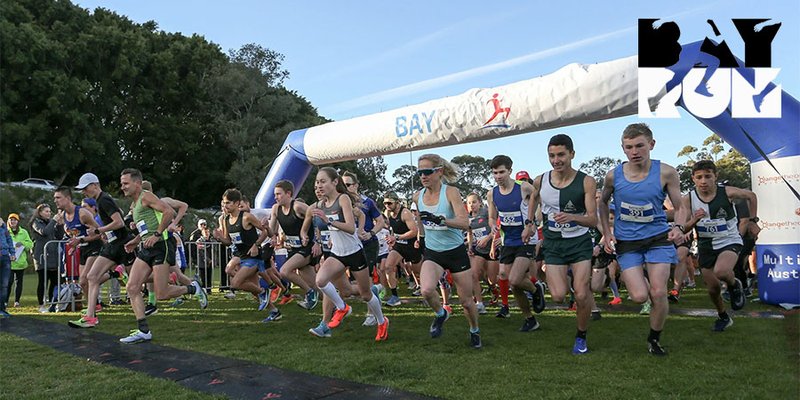
The loop around Iron Cove is one of the most-run stretches of path in Sydney. It measures almost exactly seven kilometres, tracing the water through the inner-west from Leichhardt around to Drummoyne, and thousands of people run it every week as their standing circuit. The BayRun Festival on 2 August turns that everyday lap into a race, which gives it a quality most fun runs do not have: for a large part of the field, this is the course they know better than any other.
There is something clarifying about racing a route you normally train on. The pace you can only hold for a rep suddenly has to last the whole loop; the corner where you usually ease off is where someone goes past you. Regulars come to the BayRun to find out what their circuit is actually worth when they stop pacing themselves and start racing, and that turns a flat waterfront seven-kay into a genuinely personal test.
For everyone else it is one of the most accessible races in the city. The path is flat, sealed and continuous, the whole loop is reachable by public transport, and seven kilometres is a distance a first-timer can train for in a few weeks without it taking over their life. Families walk it, club runners race it, and both have a good morning by the water.
This is a race for inner-west locals settling a private score with their own training loop, and for anyone wanting a low-barrier entry into racing that does not demand a marathon's commitment. It is not a challenge in the terrain sense — there is no hill, no trail, no drama. Its appeal is the opposite: a familiar circuit, a flat fast morning, and a reason to run it properly for once.
The six races here have almost nothing in common on paper. A flat coastal marathon and a hundred kilometres of frosted capital trail are barely the same sport, and the person chasing a personal best on the Sunshine Coast esplanade wants something the runner flying to Flinders Island has quietly decided not to care about. What links them is only the month — the deep-winter weeks when the whole country is finally cool enough to run hard, each place offering its own version of what that is worth.
That is the useful thing about a national calendar rather than a local one. It lets you see that a race is never just a distance; it is a distance in a particular place, at a particular time of year, for a particular kind of morning. The trick is not finding the best race. It is working out which of these is yours, and then giving winter a reason to have been worth it.