By November the argument has flipped. For most of the year Australian race organisers are working around weather that is either too cold to start early or too hot to finish late; in November, briefly, the constraint becomes the calendar itself. Everything wants to happen before the summer shuts the long-distance season down, which is why the first two weekends of the month are so crowded — three of the five races below are on the same Saturday, in three different states, and none of them is a minor event.
It is also the month where the reason a race exists starts to show through more clearly than the distance. That is not sentiment, it is just what November's calendar happens to contain this year: a Tasmanian fun run that has raised more than $123,000 for a children's intensive care unit, a South Australian festival that has put $108,000 into mental health programs in its own region, and a Victorian trail festival founded by a country GP to get people to come back to a town that had burned down. You can run all three without knowing any of that. It is better to know.
Five races follow, from 1 to 14 November, across Tasmania, New South Wales, Victoria, Queensland and South Australia. Western Australia is missing this month, which is not for want of events — the state has a full November — but because none of what is on had a photograph worth putting next to it, and this feature does not run event logos. Take that as a prompt to look at the Western Australian calendar yourself rather than as a verdict on it.
The far south of Tasmania has a half marathon in its third year and a fundraising record in its eighth
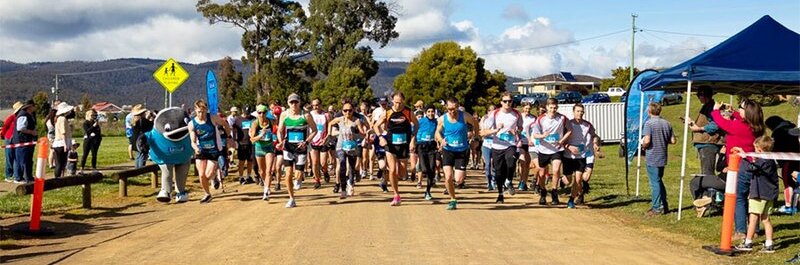
Dover is about an hour and a half south of Hobart, which in Tasmanian terms means it is a long way south of almost everything — the town sits on Port Esperance with Adamsons Peak behind it, and the road does not continue much further. The Dover Fun Run on 1 November has been raising money for the Royal Hobart Hospital's paediatric intensive care unit since 2019, and has now passed $123,000, which for a town of a few hundred people is a genuinely startling number.
The programme is four distances: a 2km on closed roads for children at $20, a 5km at $40 that the organisers say sells out every year, a 10km at $50 for ages twelve and up, and the Dover Half Marathon at 8:00am for $95. The half is the newcomer — this is only its third running — and the organisers describe it as Tasmania's answer to the Great Ocean Road half, which is a bold claim that the terrain mostly supports: it is a coastal course with real elevation rather than a flat foreshore loop, and the views across the bay are the compensation for the climbing.
The specific thing worth knowing is the 5km selling out. That is not a big-city sell-out driven by an entry cap set for crowd control; it is a small community where a substantial fraction of the town enters, and it means leaving your entry until the last week is a real risk in a way it would not be for a metropolitan fun run of the same size. Enter early or plan on the 10km.
One more thing about Dover worth saying plainly: the fundraising is not a sponsor arrangement, it is the event's reason for being. The Royal Hobart's paediatric intensive care unit takes children from across the state, which for a family in the far south means a two-hour drive at the worst moment of their lives. A town that has sent more than $123,000 up that road since 2019 is not doing charity in the abstract. It is buying equipment it hopes never to need.
Who it suits: a Hobart runner who has never been further south than Kingston, a family wanting a weekend somewhere genuinely remote, and — for the half — anyone who likes a hard coastal course without a big field. Who it does not: someone chasing a fast time, because the half is not a fast course and does not pretend to be. Far South Tasmania in early November is unpredictable weather; bring more layers than the forecast suggests, and stay the night rather than driving down at dawn.
Three races, one Saturday, and the only real question is which state you're in
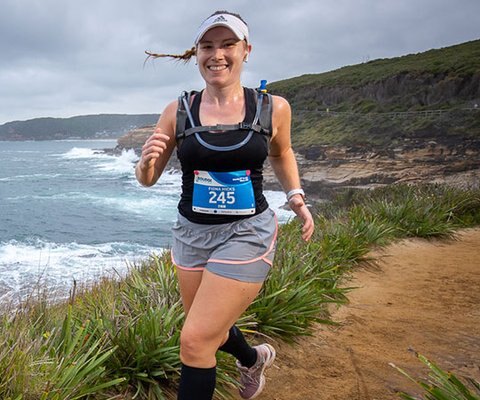
Saturday 7 November is the busiest day on this month's calendar, and the Bouddi Coastal Run is the reason many Sydney runners will not be in Sydney. Bouddi National Park sits on the Central Coast at Killcare, ninety minutes north of the city, and the course strings together the coastal walking track: clifftop lookouts, hidden beaches, sandy sections that punish anyone who went out hard, and rocky ground that requires attention rather than just fitness.
There are two distances, 14km and 21km, plus a 1km kids' beach run, and the choice between the two is less about fitness than about how much technical ground you want. The 21km is not twice as hard as the 14km; it is somewhat more than twice as hard, because the extra distance is weighted towards the rougher sections. If you have done road half marathons and this would be your first trail one, the 14km is the more honest starting point and you will still see the best of the park.
What makes Bouddi worth travelling to rather than running a coastal track by yourself on any weekend is access. Substantial parts of this route are awkward to reach without a car shuffle, and the race handles that — you run point-to-point-ish through terrain that would otherwise cost you a day of logistics. It is also a Saturday event, which leaves the Sunday free, and the organisers lean into the weekend-away framing with accommodation around Killcare and Hardys Bay.
The other reason to prefer the 14km, if you are undecided, is that it finishes with enough left to enjoy the part of the day that follows. Killcare and Hardys Bay are small, and the post-race crowd ends up in the same two or three places, which makes this one of the more sociable trail races on the Sydney fringe. Runners who blow themselves apart on the 21km tend to spend that hour lying on the grass instead.
Early November on that coast is close to ideal: the water is warm enough to swim afterwards, the humidity has not arrived, and the wildflowers on the headlands are still out. It suits a competent runner who wants coastline rather than forest, and it suits families given the beach run. It suits less well anyone who wants a measured, comparable time — this is a trail course where conditions and tide-affected sand make year-on-year comparison close to meaningless.
A country doctor built a trail festival to get people to come back to a town that burned
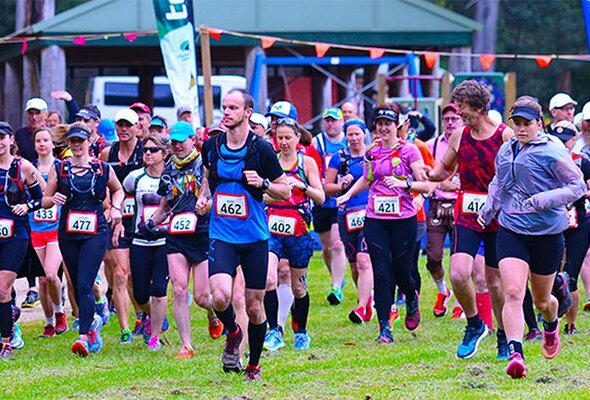
Marysville was effectively destroyed on Black Saturday in February 2009. The Marysville Marathon Festival was started afterwards by Dr Lachlan Fraser, a local GP and ultra runner, with a specific and unromantic goal: not a memorial, but a recurring annual reason for people to drive up, stay the night, and spend money in a town that needed visitors more than it needed sympathy. Seventeen years on, it is the largest weekend of the year in the Yarra Ranges town.
The programme is unusually deep for a regional festival, running across 7–8 November from Gallipoli Park: a 100km that starts at 9:00pm on the Saturday night for $240, a 50km at 7:00am for $125, the marathon at 8:00am for $115, a half at 9:00am for $95, a 10km at 10:00am for $75, and a 4km plus a kids' dash. There are also two events called KQOM14 and KQOM7 — timed climbs rather than conventional races — at 3:00pm and 4:00pm on the Saturday.
The 9:00pm start for the hundred is the detail worth planning around. It means the long race is run mostly in darkness through mountain forest, with the field spreading out fast, and it means a support crew is committing to an overnight rather than a long day. It also means that by the time the marathon and half fields come through on Sunday morning, there are hundred-kilometre runners still out on course — which produces a particular atmosphere on the shared sections that runners who have done both distances tend to describe as the best part of the weekend.
Entry prices are worth noting as a group, because they are low for what is on offer — $115 for a trail marathon and $95 for a trail half are below what most Victorian equivalents charge, and the 100km at $240 is well under the going rate for a hundred with full aid. That is deliberate. An event built to bring people to a town works better when the entry fee is not the thing that stops them coming.
The courses follow the Steavenson River through fern gullies and towering forest, past Steavenson Falls, with the longer distances climbing into the ranges for the views. This is proper Victorian high-country trail: soft underfoot, steep in places, and green in a way that surprises people who only know Victoria's dry western half. It suits a trail runner at almost any level, given the range from 4km to 100km. It suits less well someone wanting a single flagship distance and a fast time — the whole design here is a festival across two days, and treating it as one race misses what it is for.
Queensland's state mountain running title is decided on 1,200m of climb an hour from Brisbane
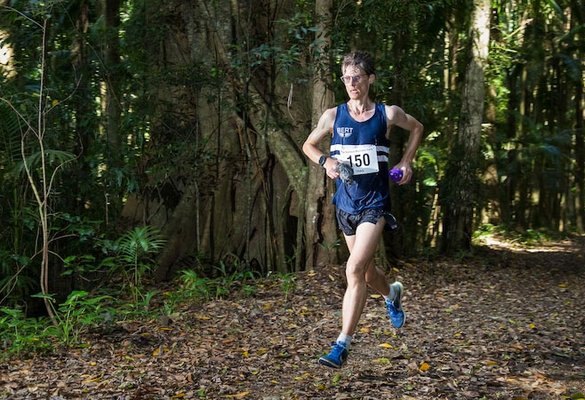
Most runners assume mountain running championships happen somewhere alpine. In Queensland they happen at Mount Glorious, in the D'Aguilar Range about an hour from Brisbane, and in 2026 the TRAQ Mt Glorious Mountain Trails on 8 November is hosting the Queensland Open Mountain Running Championships in conjunction with Queensland Athletics. That changes the character of the day: a state title on the line means the front of the field is genuinely contested rather than a few locals having a hard morning.
The championship distance is 22km with about 1,200m of climbing and 650m of descent, off at 7:00am for $95. Those numbers are worth reading twice — 1,200m of gain over 22km is a climbing rate closer to a European skyrace than to a typical Australian trail race, and the asymmetry between ascent and descent tells you the course does not simply go up and come back the same way. There is also an 11km, nicknamed the Baby G, with roughly 650m of climb, which hosts the Queensland U20 Junior Championships and is open to everyone else as a short-course option.
The 11km is new this year, and it is the right entry for most people reading this — half the elevation, the same mountain, and the chance to watch a state championship being decided rather than be lapped by one. It is also the rare short trail race where the field will contain genuinely fast juniors, which is worth seeing.
The pairing of an open championship with a junior one on the same morning is also worth turning up for even if you are not racing either. Mountain running is a small discipline in Australia and its junior pathway is smaller still; a state title that puts under-20s on a real mountain course, rather than a park circuit, is how that changes. Queensland Athletics being involved means the results count for something beyond the day.
Subtropical rainforest at Mount Glorious is dense, humid even in November, and the footing under the canopy stays damp long after rain. This suits a strong hill runner who wants a hard, short, honest course and does not mind that a 22km will take considerably longer than their usual 22km. It does not suit a first trail race — the climbing rate is unforgiving, and the descent is where inexperienced runners get hurt. If you are Brisbane-based and have been driving to the Sunshine Coast hinterland for trail, this is closer, steeper and better contested.
The Limestone Coast turned a running festival into a mental health programme
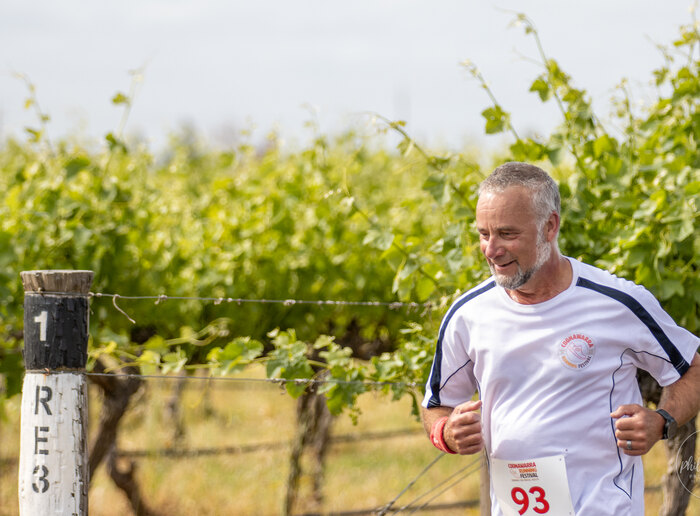
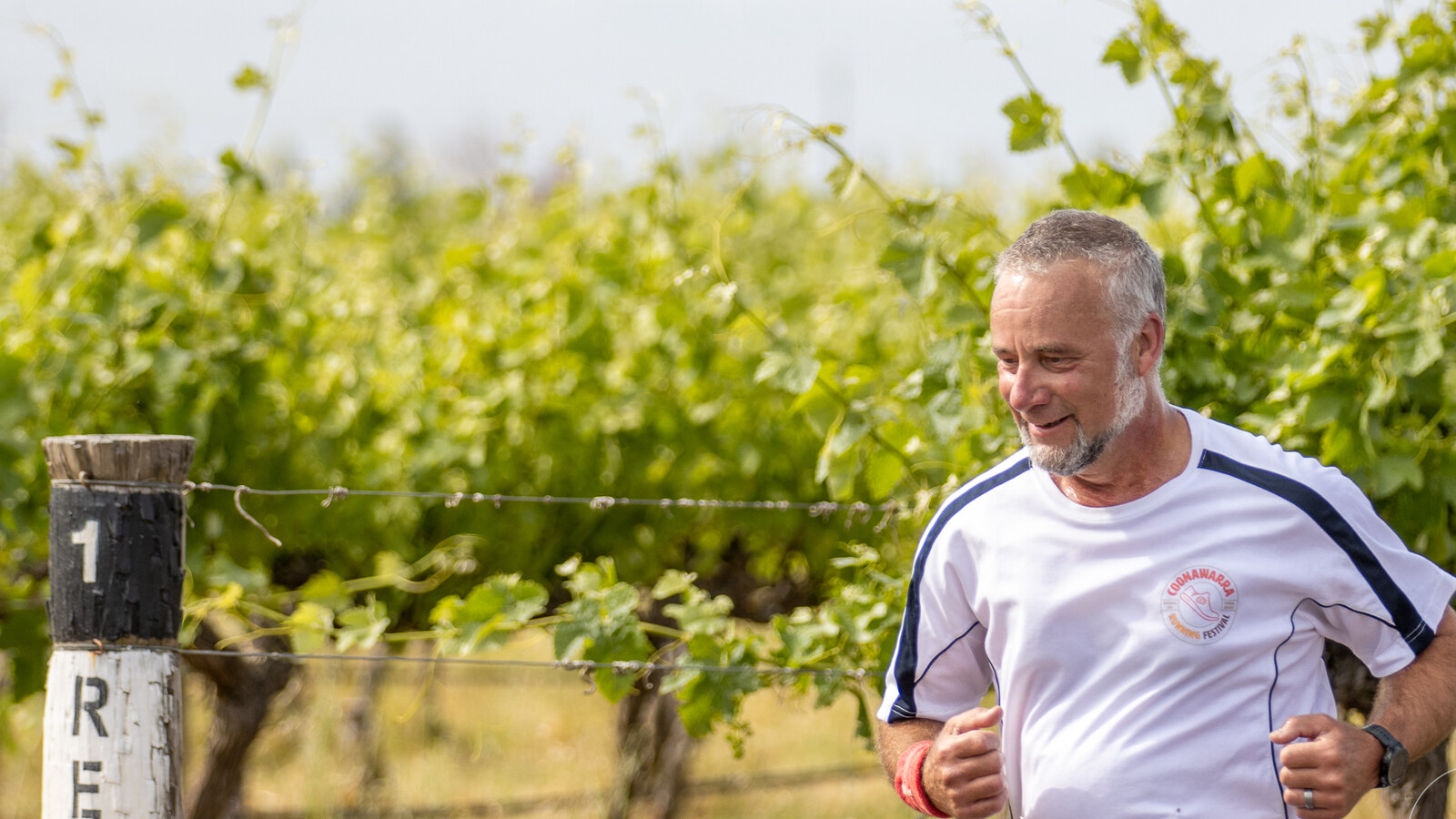
Coonawarra is a strip of red terra rossa soil about fifteen kilometres long in South Australia's south-east, and it produces some of the country's best cabernet because of it. The Coonawarra Running Festival on 7 November runs through the vineyards themselves rather than past them, which is a rarer thing than wine-region races usually deliver — most of them route along the road with a view.
Its stated purpose is mental health in the Limestone Coast, and the numbers behind that are specific: $108,000 raised across four years, which has funded a pilot Youth Mental Health Awareness Program delivered free to students at Penola High School and Lucindale Area School. The organisers' goal is to reach every high school student in the region. That is a small, concrete, checkable ambition rather than a general association with a cause, and it is the reason to choose this over a metropolitan half on the same weekend.
The programme is built around a half marathon, with a 12.6km, a 6.3km and a 1km for children, plus market stalls and a car show alongside the finish. The distances are unusual numbers because they are dictated by the geography — vineyard blocks and access tracks do not arrange themselves into round figures — and the running surface is a mix of firm dirt between the rows and sealed road connecting the blocks. Early November has the vines in full leaf and green, well before harvest, which is what makes the photographs of this race look the way they do.
A practical note on the surface: vineyard rows drain well but they are not flat in the way a road is, and the transitions between dirt and bitumen come often enough that a shoe choice matters more than the distance suggests. Road shoes are fine in the dry. If the week before has been wet, the red soil that makes the wine good also makes the tracks heavy, and a trail shoe is the safer call.
This suits a runner who wants a half marathon with a genuine sense of place, and anyone who was going to visit the region anyway — Coonawarra is a three-and-a-half hour drive from Adelaide and about four from Melbourne, so it is realistically a weekend rather than a morning. It does not suit a runner who needs a certified, comparable course, and it is not a race to travel to purely for the running. Go for the region, run the half while you are there, and stay Saturday night, which is the only sensible plan in a wine district anyway.
The three fundraising totals in this month's list — $123,000 in Dover, $108,000 in Coonawarra, and seventeen years of visitors returning to Marysville — are worth putting next to each other, because none of those races is large. Dover has a few hundred entrants. Coonawarra is a regional festival in a town most Australians could not place on a map. What they have instead of scale is persistence: the same event, the same weekend, year after year, until the number gets big.
That is a quietly encouraging thing about the sport in a country this spread out. The races that end up mattering most to a place are rarely the ones with the biggest fields or the fastest courses. They are the ones that came back the following year, and then kept coming back, until the town started arranging its calendar around them. Most of the entries on this list are that kind of race, and the entry fee is the whole mechanism.