
In This Guide
What's the Difference?
At the most basic level, road running happens on sealed surfaces — bitumen, concrete, paths — while trail running takes you off-road onto dirt, rock, sand, and everything in between. But the real differences go much deeper than surface type.
Surface & Terrain
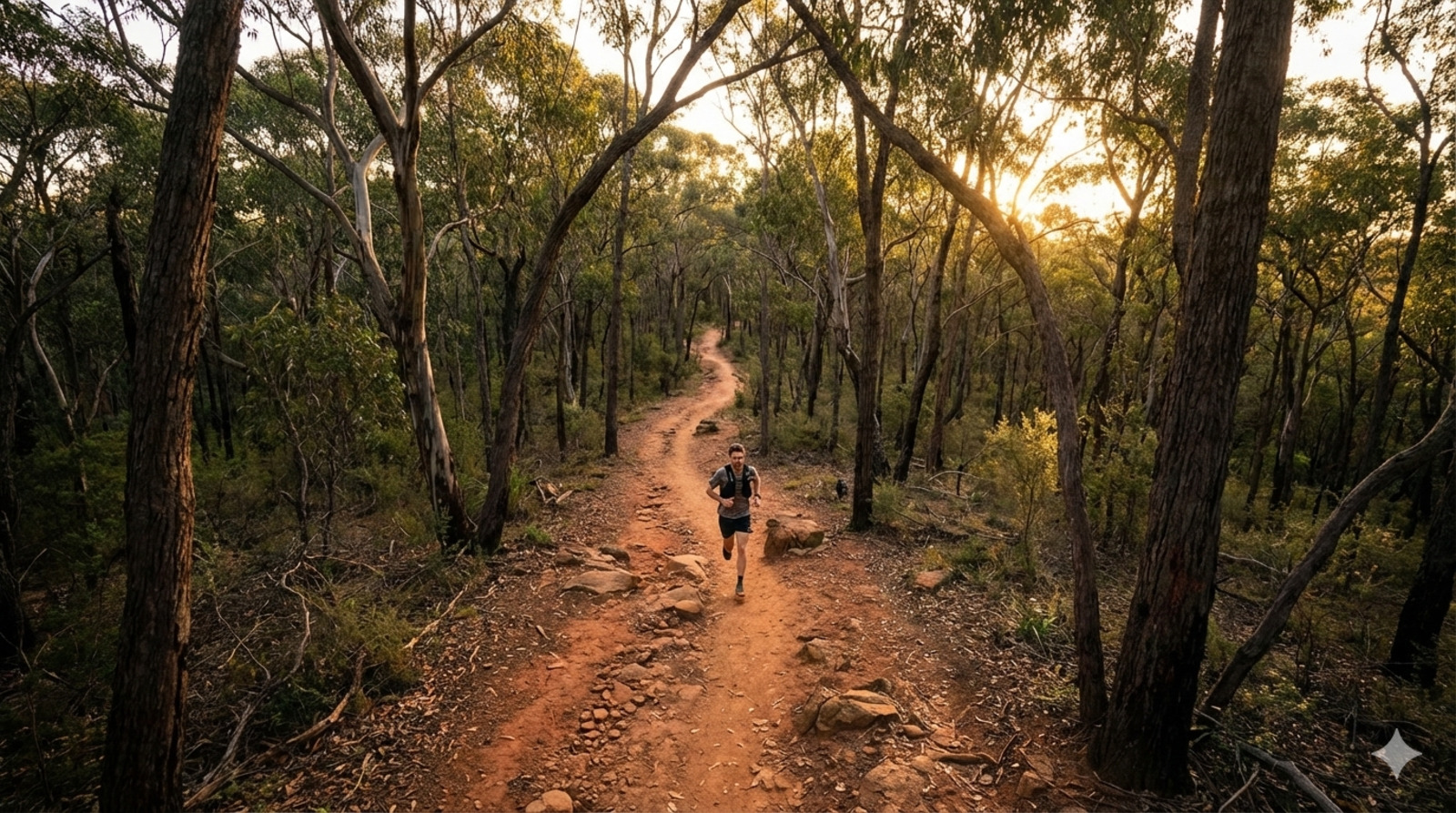
Road courses are predictable. The surface is uniform, elevation changes are usually gradual, and you can settle into a rhythm without much thought about foot placement. Trail terrain is wildly variable. Within a single kilometre you might cross loose gravel, step over tree roots, splash through a creek, and scramble up a rocky ridge. In Australia, trails often include red dirt fire roads, coastal sandstone tracks, dense bush singletrack, and alpine paths above the tree line.
Navigation
Road races are clearly marked with directional signage and marshals at every turn. Trail events range from well-flagged courses to races that hand you a GPX file and expect you to follow your watch. Some Australian ultras in remote areas require mandatory navigation skills and carry requirements.
Atmosphere
Road events tend to be larger, louder, and more spectator-friendly. Think crowd-lined streets, live bands, and cheering zones every few kilometres. Trail races are quieter and more self-reliant. You might run for an hour without seeing another person. The atmosphere is more about the landscape than the crowd — finishing a ridge climb with a view of the Blue Mountains or running along a deserted stretch of Victorian coastline.
Community Vibe
Both communities are welcoming, but the cultures differ. Road running tends to be pace-focused and competitive, with clear time goals and PB chasing. Trail running leans more toward adventure and shared experience. At many trail events, especially ultras, the competitive field is small and the majority of runners are simply aiming to finish and enjoy the journey.
Pace & Performance
One of the biggest adjustments when switching from road to trail is letting go of pace. If you run a comfortable 5:30/km on flat road, you might find yourself running 7:00 or 8:00/km on a technical trail — and that is completely normal.
Key principle: Never compare trail times to road times. A 50-minute trail 10K and a 50-minute road 10K are very different achievements. Trail pace depends heavily on elevation gain, technical difficulty, and conditions underfoot.
Elevation is the biggest factor. A trail half marathon with 1,000 metres of climbing will feel nothing like a flat road half. Many trail runners stop thinking in pace altogether and switch to effort-based running — walking the steep uphills, running the flats, and carefully managing the descents. This is not a sign of weakness; it is smart racing strategy that even elites use.
Vertical gain per kilometre (often listed as "D+" in race profiles) is a far more useful metric than expected pace when choosing a trail race. A course with 40m/km of climbing is a solid hill workout. Anything above 80m/km is genuinely mountainous and will slow all but the most experienced trail runners significantly.
Gear Differences
Shoes
This is the single biggest gear difference. Road shoes are designed for cushioning on hard, flat surfaces with a smooth outsole. Trail shoes have aggressive lugs for grip, a rock plate to protect your foot from sharp objects, and a lower profile for stability on uneven ground. Brands like Salomon, HOKA, and Altra dominate the Australian trail scene, while road runners lean toward Nike, ASICS, and New Balance.
Tip: If you only trail run occasionally on well-maintained fire roads, a hybrid shoe with moderate grip can work. But for anything technical — rocky singletrack, wet roots, loose descents — proper trail shoes are non-negotiable.
Hydration
For road races up to half marathon, you rarely need to carry anything — aid stations are frequent and reliable. Trail races, even shorter ones, often have fewer aid stations spaced further apart. A hydration vest with soft flasks is standard kit for most trail events over 20km in Australia, and many races mandate it. Carrying at least one litre of water is common even on cooler days.
Navigation & Safety
Trail races frequently have mandatory gear lists that road runners have never thought about: a charged phone, emergency whistle, space blanket, headlamp (even for day events that could push into darkness), and a rain jacket. Australian trail events in alpine or remote areas take these requirements seriously, and gear checks at the start are enforced.
Headlamps & Night Running
If you enter an ultra-distance trail race, there is a good chance you will be running in the dark. A quality headlamp with at least 300 lumens is standard. Road ultras rarely require them since city courses are lit. Night running on trail is a completely different skill — depth perception changes, you need to trust your footing, and the experience can be genuinely magical once you settle into it.
The Road Racing Scene in Australia
Australia has a mature and thriving road racing calendar, with major events in every state capital and a strong culture of club running that feeds into the race scene.
Gold Coast Marathon
Australia's premier flat marathon. The course runs along the coast from Southport to Burleigh Heads and back, making it one of the fastest marathon courses in the country. It is an AIMS-certified course and a popular choice for Boston qualifiers. The festival weekend also includes a half marathon, 10K, and 5.7K fun run, drawing over 25,000 participants each July.
Melbourne Marathon Festival
Held in October, this is one of the oldest continuously-run marathons in the Southern Hemisphere. The course loops around the Tan, passes the MCG, and finishes at the Botanical Gardens. The half marathon and 10K events attract huge fields and the atmosphere is electric.
City2Surf
The world's largest fun run, with 80,000+ participants running 14km from the CBD to Bondi Beach each August. It is not technically a road race in the competitive sense — most people walk it — but the elite field is fierce and the event is a Sydney institution.
Sydney Marathon
Running across the Harbour Bridge is a bucket-list experience. The September event has grown significantly in recent years and now holds World Athletics Gold Label status, attracting international elites alongside local club runners.
Canberra Marathon
A fast, flat course around Lake Burley Griffin that consistently delivers PBs. Held in April when Canberra's autumn weather is usually ideal for distance running — cool, dry, and still. It is a favourite among serious marathon runners who want a genuine shot at a personal best.
Road running strengths: Precise pacing, measurable progress, large supportive crowds, accurate course distances, and the thrill of chasing time goals on certified courses.
The Trail Racing Scene in Australia
Australia's trail running scene has exploded in the past decade. The country's diverse landscapes — from temperate rainforest to red desert to alpine high country — provide some of the most spectacular trail courses anywhere in the world.
Ultra-Trail Australia (Blue Mountains)
The flagship event. Held each May in the Blue Mountains west of Sydney, the course takes runners through the Jamison Valley with jaw-dropping views of sandstone cliffs, waterfalls, and ancient eucalyptus forest. Distances range from 22km to the full 100km ultra, which includes over 4,500 metres of climbing. It is part of the Ultra-Trail World Tour and attracts international elite fields alongside hundreds of first-time trail runners tackling the shorter distances.
Surf Coast Century
A 100km trail ultra along Victoria's Great Ocean Road coast, split into team and solo options. The course follows the Surf Coast Walk through coastal heath, clifftop paths, and beach sections. Held in September, it is widely considered one of the most scenic trail races in Australia and a great first 100km for runners who prefer rolling coastal terrain over alpine climbing.
Heysen 105
South Australia's premier trail ultra follows sections of the famous Heysen Trail through the Adelaide Hills. The 105km course traverses eucalyptus forest, open farmland, and creek crossings. It is a genuinely tough race with significant elevation, but the single-track trail running through the Hills is some of the best in the country.
Great Ocean Road Running Festival
This event blurs the line between road and trail with courses that mix sealed road with coastal path sections. The marathon and half marathon start in Lorne and finish in Apollo Bay, following one of the most iconic stretches of coastline in Australia. It is a destination race that many runners return to year after year.
Boutique Trail Events
Beyond the big names, Australia's trail calendar is packed with smaller, character-rich events. National park trail runs in the Grampians, Margaret River, Cradle Mountain, the Larapinta Trail, and the Snowy Mountains offer intimate race experiences with often fewer than 200 runners. These events are where many trail runners find their love for the sport — small fields, stunning locations, and a genuine sense of adventure.
Trail running strengths: Immersion in nature, physical variety, mental resilience building, and the deep satisfaction of completing a challenge defined by the landscape rather than the clock.
Which Is Right for You?
The honest answer is that it depends on what you enjoy and what you are training for. Here is a side-by-side comparison to help you think it through:
| Road | Trail | |
|---|---|---|
| Pace Focus | High — time goals drive training | Low — effort and finish are the goals |
| Scenery | Urban landscapes, city landmarks | Bush, coast, mountains, national parks |
| Gear Needed | Minimal — shoes, watch, race kit | More — trail shoes, vest, mandatory gear |
| Typical Distances | 5K to marathon | 10K to 100km+ |
| Social Scene | Large fields, pace groups, spectators | Smaller fields, self-reliant, aid station camaraderie |
| Injury Profile | Repetitive stress — shins, knees, IT band | Ankle rolls, falls, varied but less repetitive |
Tip: If you are drawn to nature and do not mind slower paces, try trail. If you love data, splits, and measurable progress, road racing will suit you. But most runners who try both find value in each.
Can You Do Both?
Absolutely — and many of Australia's strongest runners do exactly that. The two disciplines complement each other more than most people realise.
How Road Helps Trail
Road training builds aerobic efficiency, pacing discipline, and raw speed that translates directly to trail. A runner who can hold 4:30/km on the road will have a much larger aerobic reserve to draw on during long trail climbs. Structured road sessions like tempo runs and intervals build the cardiovascular engine that trail running demands.
How Trail Helps Road
Trail running builds strength in muscles that road running neglects — particularly the stabilisers around the ankles, knees, and hips. Running on uneven surfaces improves proprioception and balance. The climbing and descending builds quad and glute strength that road-only runners often lack. Many coaches recommend weekly trail runs as a form of strength work, even for runners whose goal races are on the road.
A common Australian approach: Train primarily for one discipline per season. Target a road PB in autumn (Melbourne Marathon in October or Canberra in April), then switch to trail focus for a winter or spring event (Ultra-Trail Australia in May or Surf Coast Century in September). This approach keeps training varied and reduces burnout.
The Australian running community is increasingly blended. You will find trail runners at your local parkrun on Saturday morning and road marathoners entering their first 50km trail ultra. There is no rule that says you have to choose. The best runners — and the happiest ones — tend to be those who mix it up and let the landscape and the season dictate what they run.